

Harrison Barrett, PhD
Links
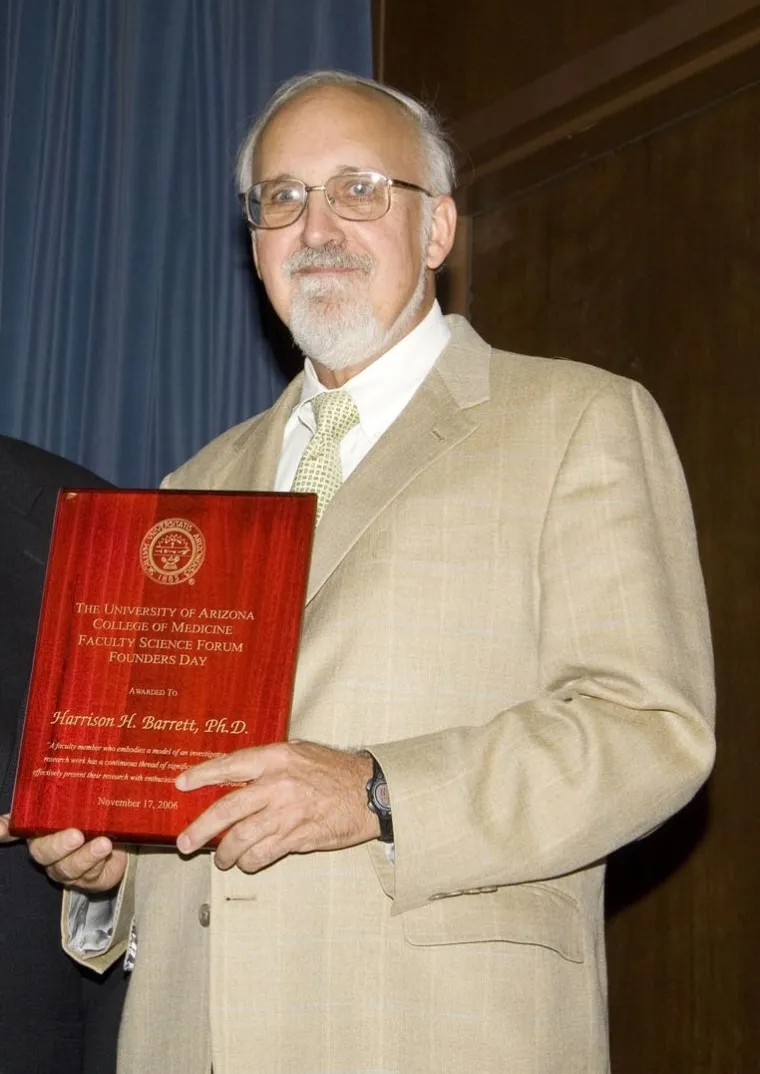
Dr. Harrison H. Barrett was recognized as the cornerstone of the Radiology and Imaging Sciences Research Division, holding the remarkable distinction of securing NIH funding for 45 consecutive years. He also founded the Center for Gamma-Ray Imaging, which sustained continuous support for more than two decades. Prior to joining the University of Arizona faculty in 1974, Dr. Barrett worked at the Raytheon Research Division.
Throughout his prolific career, Dr. Barrett was awarded 30 U.S. patents and authored or coauthored more than 250 scientific publications. Under his mentorship, 64 students earned their doctoral degrees. In collaboration with Kyle J. Myers, he co-authored the influential textbook "Foundations of Image Science," which received the first biennial J. W. Goodman Book Writing Award from OSA and SPIE in 2006.
Dr. Barrett held joint appointments in the departments of mathematics and biomedical engineering and was a member of the University of Arizona Comprehensive Cancer Center.
Together with his wife, Catherine “Cathy” Barrett, he established the Harrison H. and Catherine C. Barrett Endowed Chair in Optical Sciences for Cancer Imaging, which is currently held by Professor Lars Furenlid. This endowed chair stands as a lasting testament to their shared commitment to advancing science in the service of patients and society.
In 2019, following his retirement celebration, Tammy Orr published a tribute article titled "Reflections: Harrison H. Barrett", highlighting his extraordinary contributions to science and education.
Degrees
- Honorary Doctorate: Engineering and Architecture, University of Ghent, Belgium, 2014
- PhD: Applied Physics, Harvard University, 1969
- MS: Physics, Massachusetts Institute of Technology, 1962
- BS: Physics, Virginia Polytechnic Institute, 1960
image science; SPECT, PET and CT imaging; molecular imaging; theoretical and psychophysical investigations of image quality; applications of parallel computing in imaging; astronomical imaging and adaptive optics; optical metrology with maximum-likelihood methods; electron imaging; stem cells; digital radiology and telemedicine in remote regions; clinical effects of low radiation doses