

By wiretapping the conversation between gut and brain, U of A researcher hopes to change the discussion around healthy eating
Dr. M. Maya Kaelberer’s work was recently recognized by a Pew Biomedical Scholar award, which supports outside-the-box research by early-career scientists.

Assistant Professor of Physiology M. Maya Kaelberer, PhD, knew she wanted to work with brains ever since she was 7 years old, her curiosity piqued by a picture at a friend’s house.
“My best friend’s dad was a neurosurgeon. There were all these pictures of neuroanatomy on the wall,” she recalled. She thought to herself, “This is the coolest thing ever. I want to be a neurosurgeon.”
Those intriguing images set her on the path she ultimately trekked to a career as a sensory neurobiologist, a field that combines rigorous basic science with a dash of psychology and a pinch of philosophy.
“Sensory neurobiology is about a fundamental shift between the physical world and your internal reality. Our senses don’t tell us the truth — our senses tell us what’s being filtered to help us survive,” she said. “I’m really interested in this initial filtering system of how we’re perceiving the world, because it’s going to influence all our decisions. I thought this was super cool.”
A fork in the road
As an undergrad at the University of California, San Diego, Dr. Kaelberer double majored in neuroscience and psychology, focusing on sensation and perception. Still laying the groundwork for a career in neurosurgery, she was volunteering in a hospital and working in a research lab.
“I was like, ‘Man, research is so much more fun than volunteering in the hospital!’ I decided I should get a PhD instead,” she recalled.
After completing a research internship at the Salk Institute, she knew it was the right call. She moved across the country to complete her doctorate at Yale, where she investigated the vagus nerve.
“The vagus nerve is this really cool nerve that innervates your entire viscera — your heart, your lungs, your liver, your gut, everything,” she said. “It’s the main throughway that connects the gut to the brain. One side is touching the colon, and the other side is in the brain stem activating other neurons that go on to activate feeding circuits. The colon is one cell away from direct activation in the brain.”
As she was completing her doctorate, a chance meeting with an early-career scientist at Duke University sealed her fate in the emerging field of gut-brain interaction. Diego V. Bohorquez, PhD, was opening a lab devoted to exploring this connection, focusing particularly on certain cells he suspected had a direct line to the brain.
“I was like, ‘Why don’t you just do electrical recordings to figure out if there’s a synapse between them?’ He’s like, ‘I don’t know how.’ Well, I do,” she said. “I ended up joining his lab.”
A major discovery
Dr. Kaelberer’s postdoctoral work at Duke led to one of the proudest moments of her career so far.
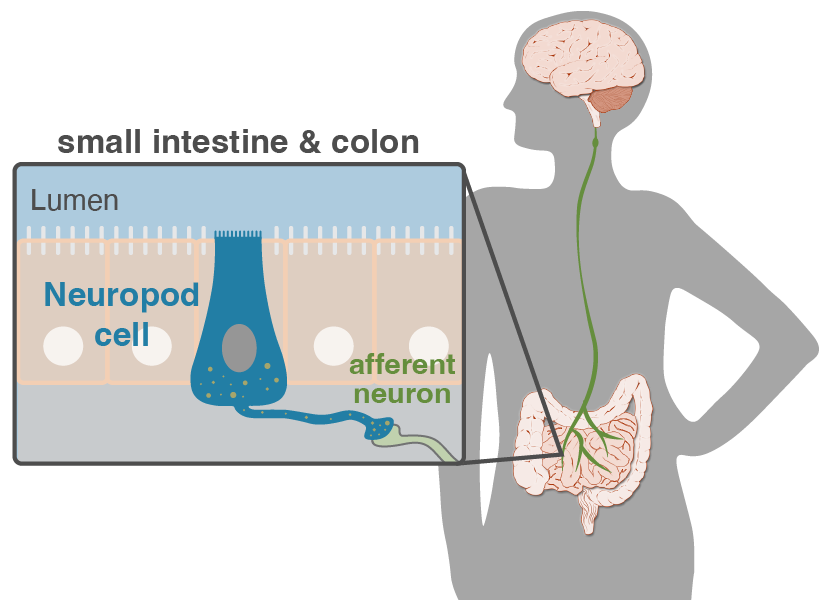
The neuropod is embedded in the small intestine and colon, and communicates directly with the brain via the vagus nerve (in green).
Courtesy of M. Maya Kaelberer
“We discovered neuropods — gut sensory cells. These cells have a fast synaptic connection to vagal neurons and drive the choice to eat one thing or the other,” she said.
Using mouse models, Dr. Kaelberer and her team at Duke learned that neuropods are like telephones that have the brain on speed dial. They worked out neurochemical pathways by which the gut communicates directly to the reward center of the brain, helping to regulate appetite.
“They can sense nutrients in the gut. With sugar, they release a signal that drives the animal to consume. These same cells have a satiety hormone,” she said. “This single cell is communicating a drive to consume while slowly releasing a hormone that tells you, ‘I’m full, it’s time to stop.’”
Dr. Kaelberer thinks this signaling between gut and brain constitutes a sixth sense — the gut sense. If we learn to be more attuned to it, she believes we might start making healthier choices.
“There’s more to food than just the reward. Sure, fast food tastes good in the moment, but how do you feel afterward?” she asked. “If you eat a meal that’s really high in micronutrients, our gut sense is telling us, ‘Mmm, that hit the spot.’ That’s our gut saying, ‘I’m getting what I need.’”
This concept is distinct from satiety and satiation, which involve the feeling of fullness. When a meal “hits the spot,” the neuropod conveys to the brain a more holistic satisfaction with a meal’s composition. Dr. Kaelberer hopes to bring this “hit-the-spotness” concept to the mainstream, starting with finding a name for it that resonates with the public.
“If we can’t name it, we have a hard time identifying it,” she said. “I want to work with other faculty — in nutrition, in linguistics — and develop a language. Once we define it, people can pay attention to it.”
Inherited tastes
One obvious response to the idea that healthful meals leave us more satisfied than junk food is the latter is designed to appeal to our senses — otherwise, we’d all choose greens over grease. Dr. Kaelberer concedes it’s not that simple, and her previous work found that dietary preferences are shaped during gestation.
“Maternal diet is going to influence the food choices of the offspring later in life,” Dr. Kaelberer said. “The gut is probably encoding nutrient signals that inform the offspring what to expect. Their sensory system gets set up to value certain foods over other foods.”
Now, as College of Medicine – Tucson faculty, she’s embarking on studies that explore this “nutritional memory” in more depth — earning the backing of a Pew Biomedical Scholar award, which will support her work over four years for a total of $280,000, as well as a five-year $1.5 million National Institutes of Health grant.
She hopes a better understanding of the nutritional memory will help identify healthier foods that scratch the same itch as high-sugar and high-fat foods. An even more ambitious goal is to figure out how to “reprogram” the gut at a cellular level to push people toward favoring healthier foods.
Looking ahead
In addition to her goals of harnessing the gut-brain connection to promote healthy eating, Dr. Kaelberer ultimately hopes her findings will change how consumers choose what to buy at the grocery store.

M. Maya Kaelberer, PhD, is an assistant professor of physiology at the University of Arizona College of Medicine – Tucson.
Noelle Haro-Gomez
“If I could change the nutrition facts label on food, that would be amazing,” she said. “Two things that are both 100 calories are going to make you feel different. What if to the side of that calorie is some kind of evaluation of what your gut sense is going to tell you about this food? Maybe the calories are equal, but this one is going to leave you feeling very gratified about what you just ate.”
By listening to the chemical conversations zipping between the gut and brain, Dr. Kaelberer sees numerous potential applications for her work, but at the end of the day is motivated by the sense of curiosity that called her to it in the first place — and the excitement of someday influencing how scientists approach obesity, nutrition, metabolic disease and public health.
“The gut sense is probably our oldest sense, because initially we were just wandering guts — but we know very little about how those signals are being filtered and how they are driving our decisions. I think it’s crazy that we haven’t figured this out yet,” she said. “There are so many questions and so many directions you can take this work. This is just such a cool field to be in.”