

MD/PhD program produces ‘bilingual’ physician-scientists who translate between the clinic and the lab
Sameeha Rashid knows the first steps toward medical breakthroughs happen in the lab. As an MD/PhD student, she investigates the heart’s power to heal itself.

From left to right: Ivan Menendez-Montes, PhD, MD/PhD student Sameeha Rashid, MS, and Hesham Sadek, MD, PhD. Rashid is working with the Sadek Lab to learn how the heart might regenerate after injury.
Anna C. Christensen
When Sameeha Rashid, MS, was young, she witnessed the power a good physician has to coach families through crisis. A few years later, she saw how advances in medical technology could transform those families’ lives.
“When I was in middle school, my younger sister was diagnosed with hearing loss. I remember feeling very confused and helpless, not being able to translate the medical terminology to my Bengali-speaking family members, but I found comfort in our physician’s care and dedication. That struck me as fundamental to who I want to be,” she recalled. “When I started college, my sister had a life-changing cochlear implant surgery — one tiny device recovered her sense of hearing. That was the moment I was confronted with how powerful medicine and scientific innovation are.”
These experiences helped inspire Rashid to pursue both an MD and a doctorate.
“I realized the two pathways are interconnected, and I haven’t looked back,” she said.
For Rashid, these pathways converge at the University of Arizona College of Medicine – Tucson through the Medical Scientist Training Program, which recently had its National Institutes of Health grant renewed for another five years.
Following her heart
After completing a BS/MS dual degree in neurobiology at the University of California, San Diego, Rashid enrolled in the College of Medicine – Tucson’s MD/PhD program in 2024. During her first two years of medical school, she was drawn to cardiology, with an eye on alleviating the tremendous burden of heart disease.
“Research in this area is very challenging, but also highly rewarding,” she said. “I feel like I could really make some impact.”
Her objective led her to the lab of Hesham Sadek, MD, PhD, director of the Sarver Heart Center and division chief of cardiology. Here, she will complete her PhD by investigating how heart muscle cells grow and proliferate, hoping to discover a way to induce self-repair in damaged cardiovascular tissue.
“The combination of strong science and strong mentorship drew me to the Sadek Lab,” she said, citing their recent work in cardiac regeneration and drug repurposing. “I wanted to adapt the incredible qualities of the team into my own identity as a physician-scientist — discipline, hard work, a drive to push science to improve patient outcomes. Mentors not only train you in skills — they shape who you become.”
Meeting the mentors
Dr. Sadek’s philosophy aligns with what Rashid seeks in a mentor.
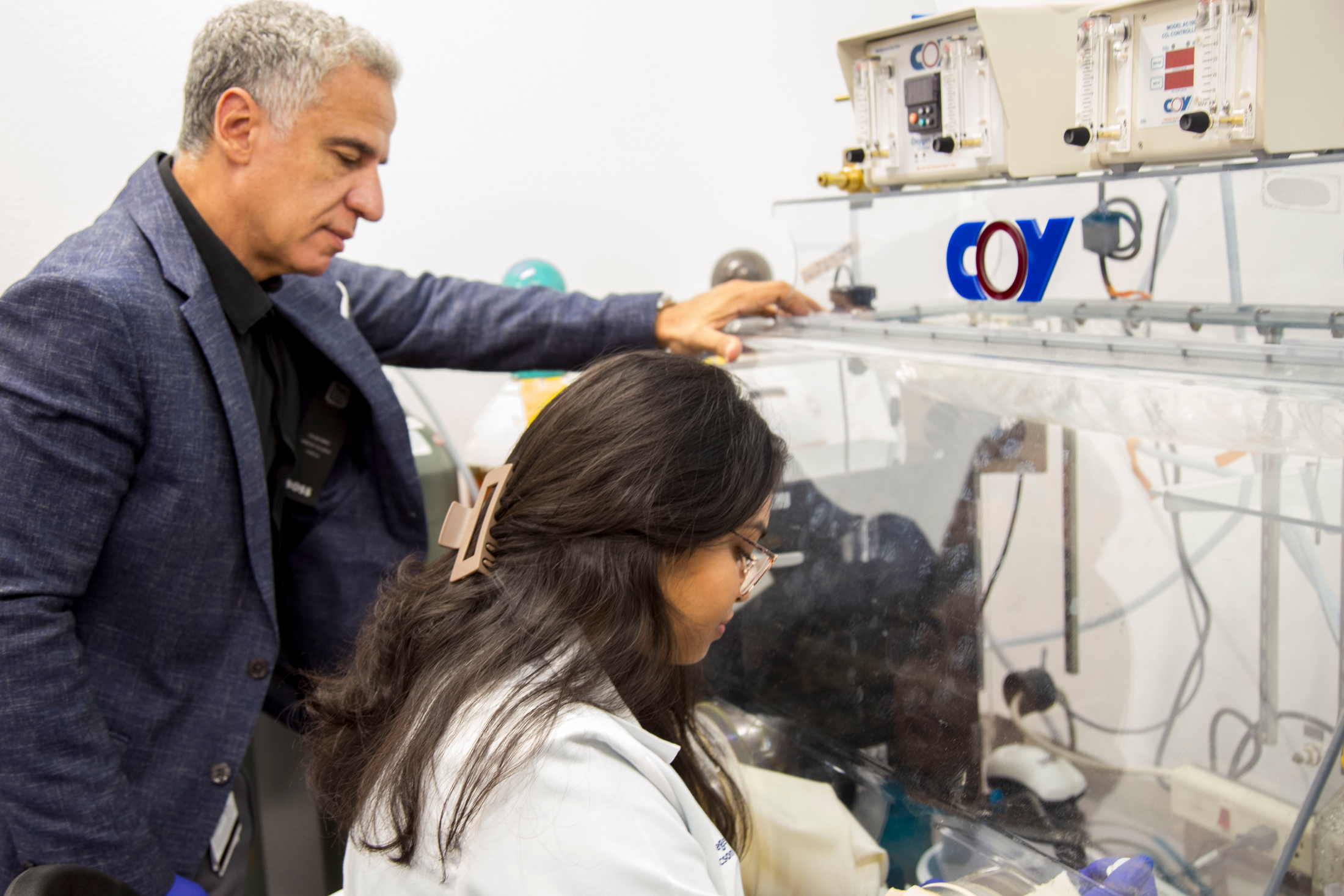
Dr. Sadek (left) says being a mentor means “Your impact on science won’t stop.”
Anna C. Christensen
“The most important thing is that she learns something about herself — and learns the scientific process,” Dr. Sadek said. “At this stage, the most important thing is to learn as much as you can, and if you happen to discover something in the process about yourself and about science, that’s great.”
She is also receiving guidance from Assistant Professor of Medicine Ivan Menendez-Montes, PhD, who has worked with Dr. Sadek for eight years.
“Hesham gave me confidence,” Dr. Menendez-Montes said. “I look at how I am now, at the end of my training. I want to have that same impact on Sameeha that Hesham has had on me.”
Dr. Sadek views mentorship as a way to extend his work as a scientist.
“To measure the impact of one’s career, two things stand out: One, if you made a discovery that changes lives. Equally important is people you have mentored, because this is perpetual,” Dr. Sadek said. “If you train 30 people, and each of them trains 30, your impact is essentially forever.”
Translating between worlds
Perhaps the most powerful way the MD and PhD degrees complement each other is by granting passage between worlds. In one world, scientists spend their entire careers discovering what’s happening at a microscopic level. In another world, physicians talk to whole human beings, giving physicals and taking histories. People with both degrees translate discovery to drive research that prioritizes patients.
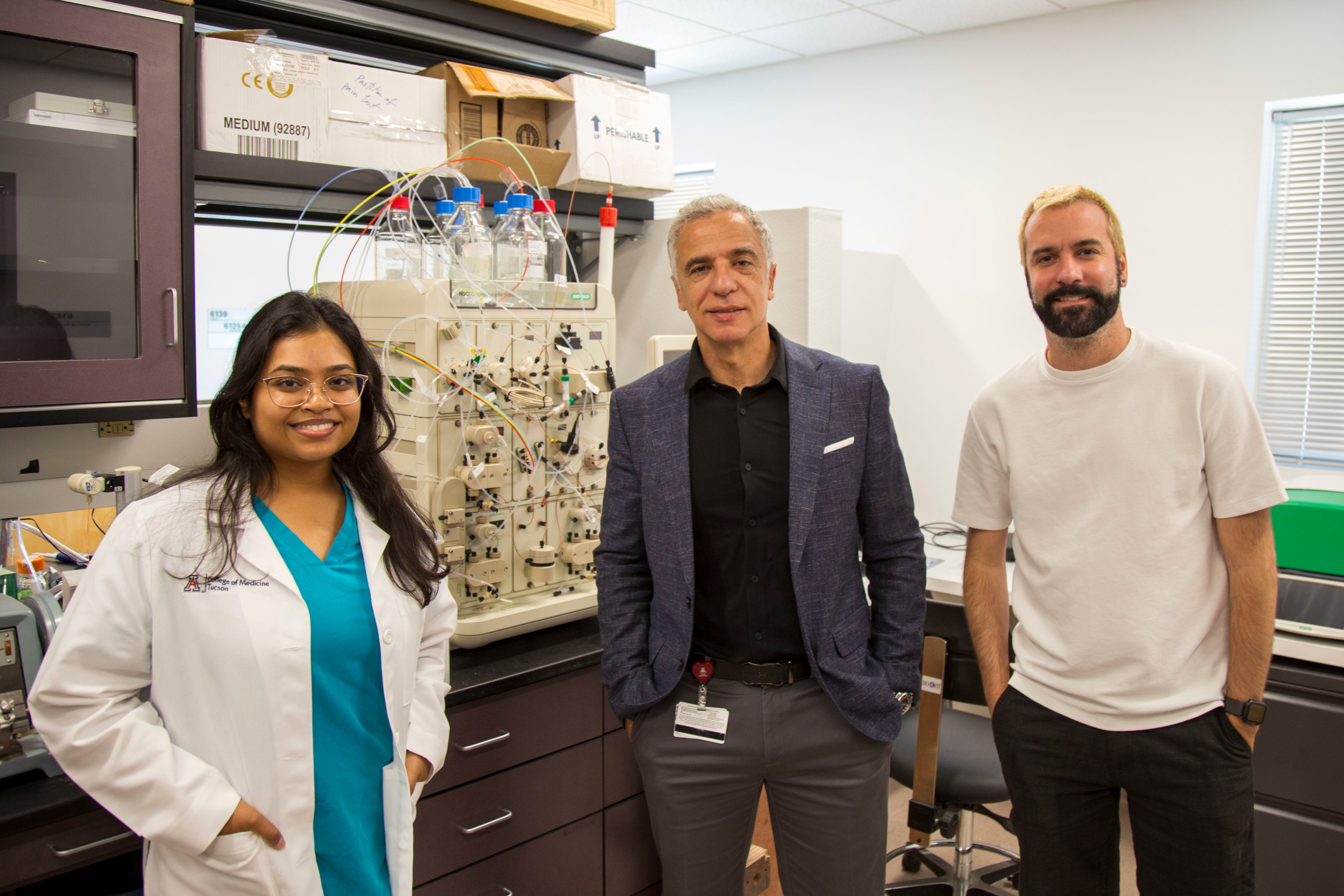
Sameeha Rashid (left) is building the toolset to confront challenges in the clinic and find solutions in the lab.
Anna C. Christensen
“Having both MDs and PhDs in my lab is a huge privilege. They provide such a breadth of knowledge and expertise; the team becomes very strong,” Dr. Sadek said. “A physician-scientist sees patients in clinic and gets ideas about what the problem is, and knows how to develop a series of studies that can potentially answer that question. In science, the question is everything.”
Dr. Menendez-Montes likens this ability to being multilingual.
“My early training was in an environment where PhDs and MDs didn’t know how to talk to each other,” he said. “Sameeha is bilingual — she can understand the lab jargon and molecular concepts, but she also knows what the patient needs. She can integrate both of those in a common language.”
Healing hearts
Immersed in the Sadek Lab, Rashid will collaborate with colleagues eyeing a valuable prize: coaxing damaged heart cells to repair themselves. Unraveling this secret might be key to addressing heart failure, which has no cure and is responsible for 14.6% of deaths in the United States.
“When a heart muscle is injured, it doesn’t grow back,” Dr. Sadek said. “After a heart attack, you lose so much heart muscle and the remaining muscle is under a lot more stress. The heart gets progressively weaker.”
But the Sadek Lab has found evidence that heart muscle can sometimes self-repair — inspiring hope that doctors might tap into an innate capacity for regeneration after life-threatening events. Rashid is excited to work in a lab abundant with such possibilities.
“The first integral step of making a difference in medicine happens in the laboratory,” she said. “One scientific breakthrough can transform medical practice for generations to come.”
Like most MD/PhD students, Rashid sees her scientific training as a powerful tool for helping patients.
“In the clinic, you can heal one patient at a time. With research, you can heal systems,” she said. “I find fulfillment in being at the edge of the unknown.”
Eventually, she hopes to complete her medical training in internal medicine and cardiology, and remain in academic medicine. Remembering medical appointments in middle school, struggling to understand what was happening to her sister and how to interpret it for her family, she ultimately wants to serve patients and families.
“Personal experience drew me into medicine,” she said, “and it evolved into this relentless curiosity to understand the biological underpinnings of disease. I want to expand the limits of medicine, recognize problems and limitations, and have the toolset to challenge that.”