

MD/PhD students don’t have to choose between careers as physicians or scientists — they do both
The future physician-scientists enrolled in this dual-degree program envision careers in which they treat patients in the clinic and innovate in the lab.
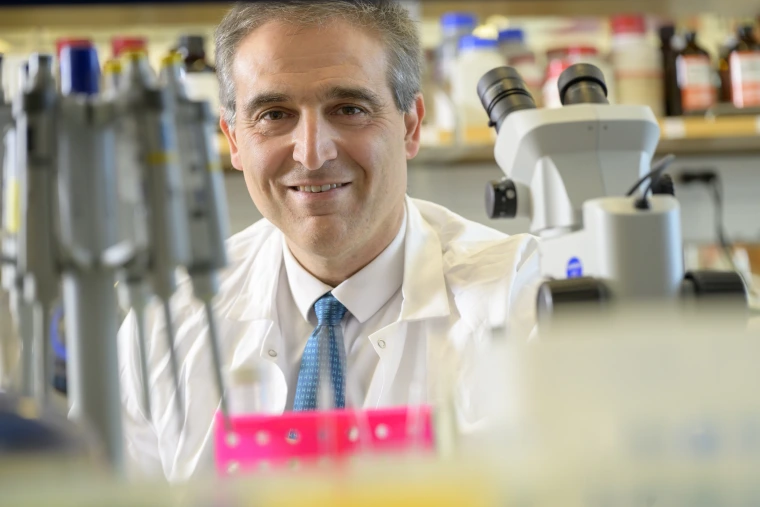
The MD/PhD Program is overseen by Dr. Hossein Ardehali, associate director of the Sarver Heart Center, associate dean for translational research and Irving L. Levinson Professor of Cardiology.
Kris Hanning, UAHS Office of Communications
As far as degree programs go, both medical degrees and doctorates in the biosciences are infamous for their challenges: highly selective admissions processes, late nights studying, years of training. Earning an MD or a PhD is an impressive enough feat on its own.
Enter the MD/PhD student, the aspiring physician-scientist who refuses to choose between the two career paths. After completing their undergraduate degree — and often with a master’s degree under their belt as well — they commit to at least seven years of intense study, all with the goal of driving change in both the clinic and the lab. Inspired by their patients, they help usher the future of medicine into existence.
The College of Medicine – Tucson launched its MD/PhD program in the 1980s, shepherding ambitious students through the first two years of medical school, followed by intensive mentorship in a laboratory to earn a doctorate, and capped off by the final two years of medical school to complete the MD.
National Institutes of Health recognition
In 2021, the college was awarded the National Institutes of Health’s Medical Scientist Training Program (MSTP) grant, which is reserved for the nation’s best MD/PhD programs. Out of more than 100 of these dual-degree programs across the country, only around half receive this recognition from the NIH.
At that time, the program was overseen by Department Head of Pharmacology Todd Vanderah, PhD, and MSTP Program Manager George Fantry, MD, who along with Vice Dean of Research and Graduate Studies Jason Wertheim, MD, PhD, and Division Chief of Gastroenterology Juanita Merchant, MD, PhD, submitted the original NIH grant and are still closely involved in the program.
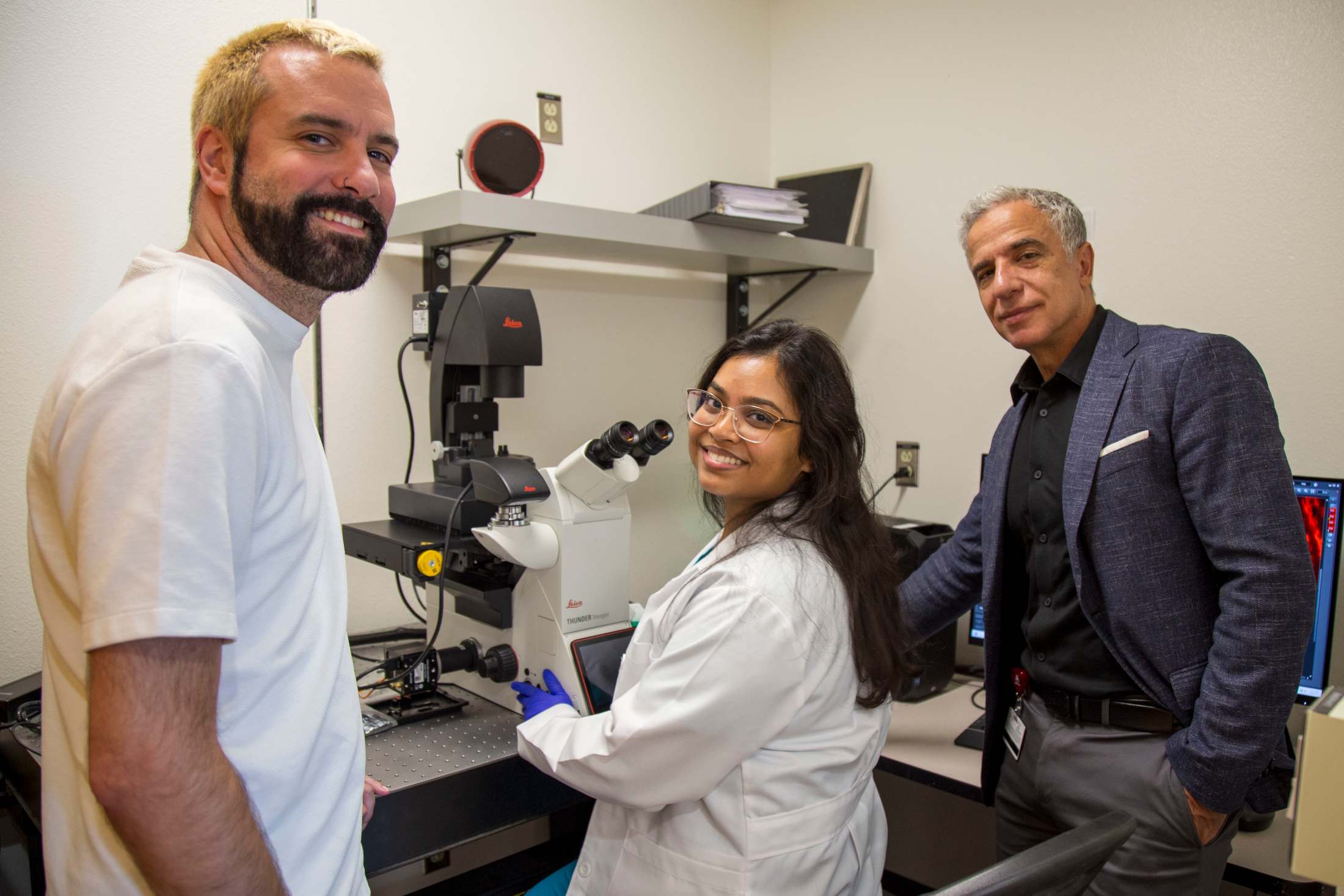
From left to right: Ivan Menendez-Montes, PhD, MD/PhD student Sameeha Rashid, MS, and Hesham Sadek, MD, PhD. Rashid is working with the Sadek Lab to learn how the heart might regenerate after injury.
Anna C. Christensen
In 2025, Hossein Ardehali, MD, PhD, was recruited to take the helm as program director.
“MD/PhD has been one of the most successful NIH programs,” Dr. Ardehali said. “The program allows trainees to bridge the gap between clinical science and basic science. They understand disease and they also understand the molecular basis of disease.”
The original five-year grant was recently renewed for another five years, totaling $2,295,518 — and it includes more slots for students, meaning the college will be able to ramp up admissions. This year, the program admitted 11 students compared to eight last year and five the year before.
“We are very fortunate that we tripled the size of the NIH-funded slots. The NIH wants to fund the top programs in the country — they support programs where trainees will end up becoming successful physician-scientists,” Dr. Ardehali said. “The NIH recognized that our program is on the rise. It’s going to be a leading MSTP in the country, and that’s why they wanted to fund it.”
“The program owes its success to strong commitments from the dean, department chairs and center directors, all of whom recruit and retain both research scientists and physician-scientists who are excited about mentoring students — with over 110 mentors available,” Dr. Vanderah added. “No matter what field our students aspire to, there is someone here who will train them how to be the best scientists they can be.”
An emerging need
Dr. Ardehali says advances in the biosciences inspired more physicians to incorporate research into their careers, leading the NIH to launch the MD/PhD program in the 1960s.

MD/PhD student Ateh Zinkeng, PSM (left) learned how to isolate proteins from Michael D. L. Johnson, PhD (right).
Anna C. Christensen
“Medicine became complicated; molecular biology became complicated,” he said. “A lot of MDs don’t get the required training to study the molecular basis and the mechanism of disease. A lot of PhDs don’t have access to patients. The MD/PhD program allows trainees to take care of patients and do research. We train them to be good physicians, good scientists and good leaders.”
Dr. Ardehali says that, over the decades, the program has expanded its scope to keep pace with scientific advances.
“In the 1990s, we had limited options. I had the option of choosing my research lab from only six departments — pharmacology, biochemistry, molecular physiology, cell biology, molecular biology and microbiology. That was basically it,” he recalled. “Today, we give them the freedom to choose almost any area of research they want to do — biomedical engineering, chemistry, public health. We had a student who went into optics to learn how to improve imaging and microscope development for diagnosing patients. The majority of them go into areas where their research can lead to potential therapy — cancer, cardiology, immunology.”
In addition to the NIH grant, incoming MD/PhD students benefit from philanthropic commitment by Joy Bunt, MD, PhD, who earned her medical degree here. Since the MSTP was initially funded in 2021, she has supported a summer research program that allows students to identify laboratories, projects and research mentors prior to the start of the academic year.
By the time they complete both degrees, the college’s MD/PhD students publish an average of four peer-reviewed manuscripts apiece, with a total of 130 manuscripts published since 2021. Many of them match into their top-rated residency programs, most of which are research-oriented, and two-thirds remain in academia.
Mentoring tomorrow’s physician-scientists
Personal experience motivated Dr. Ardehali to come to the College of Medicine – Tucson to oversee the expansion of the MSTP program. In the 1990s, he completed the program at Vanderbilt, preparing him for a career as a physician-scientist investigating new ways to treat heart disease.

MD/PhD student Andres Diaz, MS, is an aspiring pediatric oncologist, hoping to identify globally accessible treatments.
Noelle Haro-Gomez
“In my first year of medical school, I worked in the lab of the MSTP director, Daryl Granner, MD. He changed my life,” Dr. Ardehali recalled. Having originally planned on completing his MD in four years, he was so energized by the atmosphere of discovery in the Granner Lab that he knew he needed to incorporate that side of medicine into his training as well. “Dr. Granner supported me. I owe everything I have to my PhD mentor. He had an impact on so many lives.”
These days, he honors Dr. Granner’s legacy by acting as a mentor to the next generation of physician-scientists.
“It’s really great to see them become independent and successful,” he said. “This country is committed to supporting biomedical research. We are here to train the future leaders of American medicine.”
Dr. Ardehali says the medicine of tomorrow is informed by the scientific innovations of today — and watching this progress unfold is one of the most exciting aspects of his involvement in the MSTP program.
“Medicine doesn’t move forward without scientists bustling behind the scenes, making discoveries in labs and translating them into advances in preventing, diagnosing and treating disease. And we need physicians on the ground, learning from their patients to better understand their experiences and priorities, inspiring the next questions they ask as scientists,” Dr. Ardehali said. “Physician-scientists travel this two-way street between the lab and the clinic, developing a holistic understanding of where we need to take medicine as we head into the future.”


