

Radiology and Imaging Sciences
Nuclear Medicine and Theranostics

Academic Leadership and Innovation in Nuclear Medicine and Theranostics

Residents, fellows and medical students receive mentorship from nuclear medicine and theranostics experts, including board-certified nuclear medicine physicians and licensed nuclear medicine technologists. Trainees will work with state-of-the-art cameras in preparation for bringing precision medicine to their future patients and their referring physicians.
Trainees will learn to use radiopharmaceuticals (radioactive element attached to a drug) to trace different processes in patients’ bodies to diagnose different diseases, in both oncology and non-oncology settings. They will also have opportunities to train in Banner – University Medicine’s Nuclear Medicine and Theranostics Clinic, which is the first in the state to achieve the prestigious status as a designated Comprehensive Radiopharmaceutical Therapy Center of Excellence.
Trainees will learn to use different FDA-approved tracers to help stage cancers, mainly with a PET/CT scanner.
Oncology PET Tracers
- FDG: used for a variety of cancers
- PSMA: used for newly diagnosed and recurrent prostate cancer
- Fluciclovine: used for recurrent prostate cancer
- DOTA-TATE: used for neuroendocrine cancers
- FES: used for metastatic breast cancer for patients with ER-positive cancer
Oncology General Nuclear Medicine Tracers
- Iodine 131/123: thyroid cancer
- Tc99m-MDP bone scan: when cancers spread to the bones
- I123MIBG: neuroblastoma, paraganglioma, non-oncological and oncological pheochromocytoma.
- Tc99m tilmanocept or Tc99m Sulfor-Colloid-preoperative lymphoscintigraphy: mapping of lymph nodes (skin, vulvar, breast cancers)
- Tc99m MAA: evaluation prior to liver ablation with Y90
- Cancer dosimetry, I131-thyroid, Lu177
In non-oncology practice, trainees will learn to use PET/CT, SPECT or SPECT/CT, and pinhole CZT cardiac cameras to trace and diagnose many types of diseases across the body.
Brain
- Alzheimer’s disease (Amyvid PET, FDG)
- Epilepsy (FDG PET/CT, Neurolite SPECT/CT)
- Dementia and Parkinsonian (DaTscan, FDG)
- Brain perfusion studies
- Suspected brain death
- Carotid occlusion
- Diamox challenge
Eyes
- Dacryoscintigraphy (tears study)
Thyroid (hyperfunctioning)
- Graves
- Multinodular goiter
- Toxic nodule
- Subacute thyroiditis
Lungs
- Chronic thromboembolism pulmonary hypertension
- Acute pulmonary embolism
- Lung quantitation
Heart
- Perfusion study for the evaluation of ischemic heart diseases
- Cardiac amyloidosis
- Cardiac sarcoidosis
Abdomen
- Liver: HIDA
- Acute or chronic cholecystitis
- Stomach: Gastric emptying
- Peritoneal ascites shunt
- Ventricular peritoneal shunt
- Kidneys: obstruction and function
Extremities
- Lymphedema
Spine
- CSF leak
Bones (non-oncological bone scans)
- Infection
- Chronic bone disease
- Bone density (DEXA MSK section)
Whole body
- Infectious of unknown origin
- Infected hardware implants
Nuclear medicine and molecular imaging use small and safe amounts of radioactive material inside the body to see how organs or tissue are functioning (for diagnosis) or to target and destroy damaged or diseased organs or tissue (for treatment). Theranostics (a combination of the terms therapeutics and diagnostics) describes the combination of using one radioactive drug to identify (diagnose) and a second radioactive drug to deliver therapy to treat the tumor/disease.
Trainees receive support and mentorship from a multidisciplinary care team consisting of board-certified physicians specializing in nuclear medicine, hematology/oncology, endocrinology, interventional radiology, radiation oncology and surgery, as well as certified technologists, nurses, nurse practitioners, a radiation safety team and medical physicists. They will learn to provide several types of therapies:
- Thyroid ablation for thyroid cancer after thyroidectomy
- 177Lu PSMA-617 (Pluvicto) therapy
- Radium-223 chloride
- Y90 therasphere
- 177Lu DOTATATE (Lutathera) therapy
Division Chief
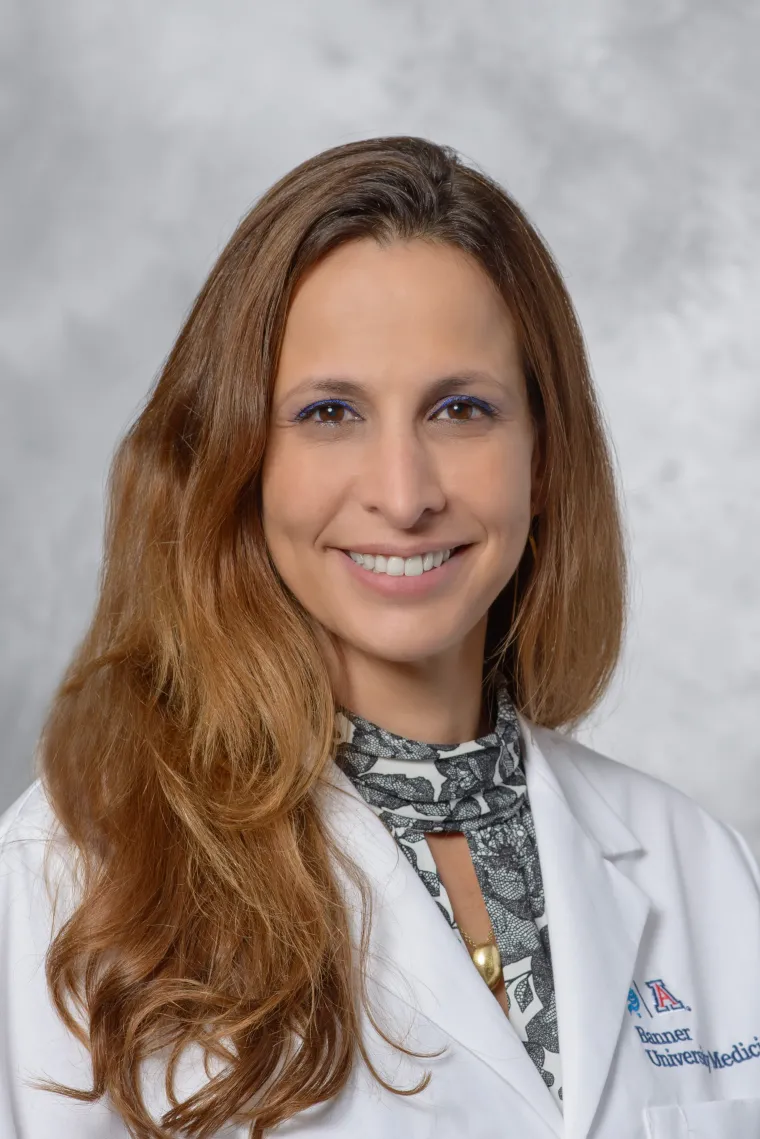
Bital Savir-Baruch, MD, MBA, FACNM
Clinical Specialties
Division Faculty

Tina Buehner, PhD

Avanka Lowe, MD

Holly Thompson, MD, MPH
Academic Excellence

Nuclear Medicine Residency Program
Our newly accredited, three-year ACGME training program prepares residents for independent practice and board certification in nuclear medicine

Nuclear Radiology Fellowship Program
This ACGME-accredited fellowship offers one year of advanced graduate medical education in nuclear radiology, providing comprehensive training across all facets of the field.
Banner – University Medicine
Nuclear Medicine and Theranostics Clinic